
What Is Hybrid Strength Training? A Clear Guide for Beginners
What is hybrid strength training? It is a planned approach that combines resistance exercise with aerobic or conditioning activity. You can pair both in one workout or include them across your training week. The useful part is not a special label or a nonstop pace. It is having a clear plan for each kind of work, adjusting the challenge to your current ability, and choosing a routine you can repeat.
Ask how to request your first free class
What does hybrid strength training mean?
Resistance exercise asks your muscles to work against a load. The load might be your body weight, a band, a dumbbell, or another piece of equipment. Aerobic activity uses larger muscle groups in continued movement, such as walking, cycling, or stepping. Conditioning can also include intervals, provided the pace and recovery are appropriate. Hybrid training gives both resistance work and heart-pumping movement a deliberate place in the plan.
Harvard Health describes hybrid exercise training as combining heart-pumping aerobic action with muscle-strengthening moves in the same exercise session (Harvard Health’s explanation). That is one useful definition. In practice, a plan can arrange the two elements in several ways. You might perform a strength movement, take a short walk, and repeat. You might finish a steady strength block with a few minutes of easy conditioning. Or you might place strength work and cardio on different days while treating them as parts of one overall routine.
The word “hybrid” does not tell you how hard the workout is, how long it lasts, or what equipment it uses. It also does not tell you whether the session is well suited to a particular beginner. Look at the actual movements, the amount of instruction, the pace, the rest periods, and the options available. A simple, well-paced combination can be hybrid training. A fast circuit is not automatically better just because it combines exercises.
How does it differ from lifting or cardio alone?
A lifting-focused routine gives most of its attention to resistance movements. A person may take recovery time between sets to practice technique, choose a suitable load, and repeat a movement with control. A cardio-focused routine centers on sustained or interval movement. It may include little resistance work or none at all. Both approaches can serve a purpose; neither is automatically the right choice for every person or every week.
Hybrid training gives the two categories a place together. The difference is in the plan, not in a promise of faster change. If you combine strength and cardio in a way that leaves you rushing through the strength movements, the mix may need adjustment. If conditioning makes it hard to stay in control, reduce its duration or intensity, add more recovery, or separate the blocks. If you are spending the whole session on one element, that may simply be a strength-focused or cardio-focused workout rather than a hybrid one.
Here is a practical comparison. Imagine a person who wants to become more comfortable with basic strength movements and also enjoys walking. A lifting-only version could practice a few movements with ample rest and omit the walk. A cardio-only version could include a comfortable walk and no planned resistance exercises. A hybrid version could keep the same basic strength practice and add a short walk at the end. None has to be an all-out test. The version that fits depends on the person’s priorities, experience, available time, and recovery.
Hybrid training also differs from a random sequence of exercises. A useful plan has a reason for the order. You might do the movements that need the most concentration first, then add an easier conditioning block. You might alternate movements to break up a session while keeping the pace manageable. Whatever the order, you should know what each part is for and how to make it easier if needed.
What can each part of a hybrid workout do?
Resistance exercise gives you a chance to practice movements against a manageable load. The movements could include sitting and standing, pushing, pulling, carrying, or bracing, depending on the person and the available coaching. The first goal for a beginner is often to understand the movement and find a version that feels controlled. You do not need to start with heavy equipment or a complicated routine to practice resistance work.
Conditioning gives the session a sustained-movement element. Walking, easy stepping, or cycling are examples of activities that can be adjusted by changing pace or duration. Some workouts use intervals, where activity and recovery alternate. Intervals need not mean sprinting. A short period of comfortable movement followed by a slower recovery is still a way to organize effort and rest.
The transition between the two matters. A session can feel manageable when each block has a clear start and finish, and when there is time to move safely from one station to another. It can feel confusing when a person is asked to change exercises quickly without knowing where to go or what an exercise means. In a coached setting, ask for a demonstration before the session begins or pause to clarify an instruction. It is better to understand the next step than to rush to keep up.
Think of the workout as two dials rather than one. One dial controls resistance work: the load, movement range, number of repetitions, and time for practice. The other controls conditioning: pace, interval length, and recovery. You can turn down either dial without abandoning the whole workout. For example, keep a familiar strength movement but shorten the walk, or keep the walk and use a supported version of a squat pattern. The right adjustment depends on what feels appropriate and what an instructor advises.
How can a beginner plan a first session?
Begin with a small, familiar structure instead of trying to assemble a long list of exercises. Choose one or two basic resistance patterns and one comfortable conditioning option. A sit-to-stand from a chair can be a squat-like pattern. A supported push against a wall or stable high surface can offer a simple pushing pattern. A short walk can provide the movement portion. These are examples to discuss with an instructor, not a personal exercise prescription.
Before starting, ask what the session includes and how to request an easier variation. It helps to know whether you will repeat a movement for a few controlled repetitions, work for a set period, or rotate among stations. Ask where to stand, when to rest, and how to signal that you need help. Clear answers reduce the pressure to copy someone else’s pace or guess what comes next.
One simple structure could look like this:
- Check in and prepare. Confirm the movements, the available easier options, and the place to take a rest. Start only when you understand the directions.
- Practice one resistance movement. Use a light or body-weight option that lets you focus on control. Stop the set when form or comfort changes.
- Recover and move easily. Take enough time to breathe comfortably, then try a short walk or easy step if that feels suitable.
- Repeat only if appropriate. Do another round only if you can move with control and understand what the exercise asks of you.
- Finish with a check-in. Note which part felt clear, which part felt rushed, and what you would like to ask about next time.
There is no requirement to begin with a full circuit. You can practice the strength movement first and then do a short conditioning block. If changing stations makes you anxious or hurried, use separate blocks. If even a short interval feels demanding, slow down, shorten it, or stop and ask the coach for another option. A session is not a test of how little rest you can take.
It is also reasonable to start with fewer movements than you expect. For example, a beginner who is unfamiliar with resistance exercise may first practice a sit-to-stand and a supported push, with an easy walk afterward. A person who already walks regularly may keep the walk as the main activity and add one or two strength patterns. The structure can grow as the person becomes more familiar with it. There is no need to add extra exercises simply to make the workout look advanced.
How do you choose the balance between strength and conditioning?
There is no universal strength-to-cardio ratio. Start by deciding what you most want to practice and what you can realistically fit into the session. If learning resistance movements is the priority, give those movements enough time for instruction and controlled practice. Keep conditioning brief and comfortable while you learn. If steady movement is already part of your routine, retain that activity and add a small amount of resistance work. Both approaches include the two elements while putting emphasis in different places.
Consider three sample plans as illustrations, not prescriptions. A person new to strength work might spend most of a short session learning two movements, then walk easily for a few minutes. A person who enjoys walking might take a familiar walk and add a small number of supported strength exercises. Someone who prefers variety might alternate one simple movement with a short, gentle movement interval, taking rest whenever needed. The best starting point is the version that leaves enough attention for safe, understandable practice.
Order can make a difference to how a session feels. Put a movement that requires more concentration earlier if you want to practice it while relatively fresh. Place conditioning after the strength block if it tends to make you tired. Alternatively, do a very easy warm-up walk before strength work if that helps you settle into the session. You can also schedule different activities on separate days. A hybrid plan does not require every component to happen in the same hour.
Use a short review after each session. Ask yourself: Could I understand the directions? Did I have enough time to practice? Was the pace comfortable enough to stay in control? Did I need more rest? Did the workout fit my schedule? Your answers are more useful than comparing your speed, repetitions, or equipment with another person’s. If the answer to several questions is no, simplify the plan before adding more challenge.
One change at a time makes it easier to learn what works. You might add a few repetitions to one familiar movement, extend an easy walk slightly, or reduce the length of a rest only if recovery remains comfortable. Do not increase the load, duration, pace, and number of rounds all at once. If a change makes the session feel rushed or confusing, return to the previous version and discuss an adjustment.
How can a coach scale the workout for beginners?
Scaling means adjusting the exercise or session so a person can take part at an appropriate level. It is not a separate category reserved for people who are unfit, and it is not a sign of failure. A coach may change resistance, body position, range of movement, repetitions, work time, pace, or recovery. The point is to find a version that the participant understands and can perform with control.
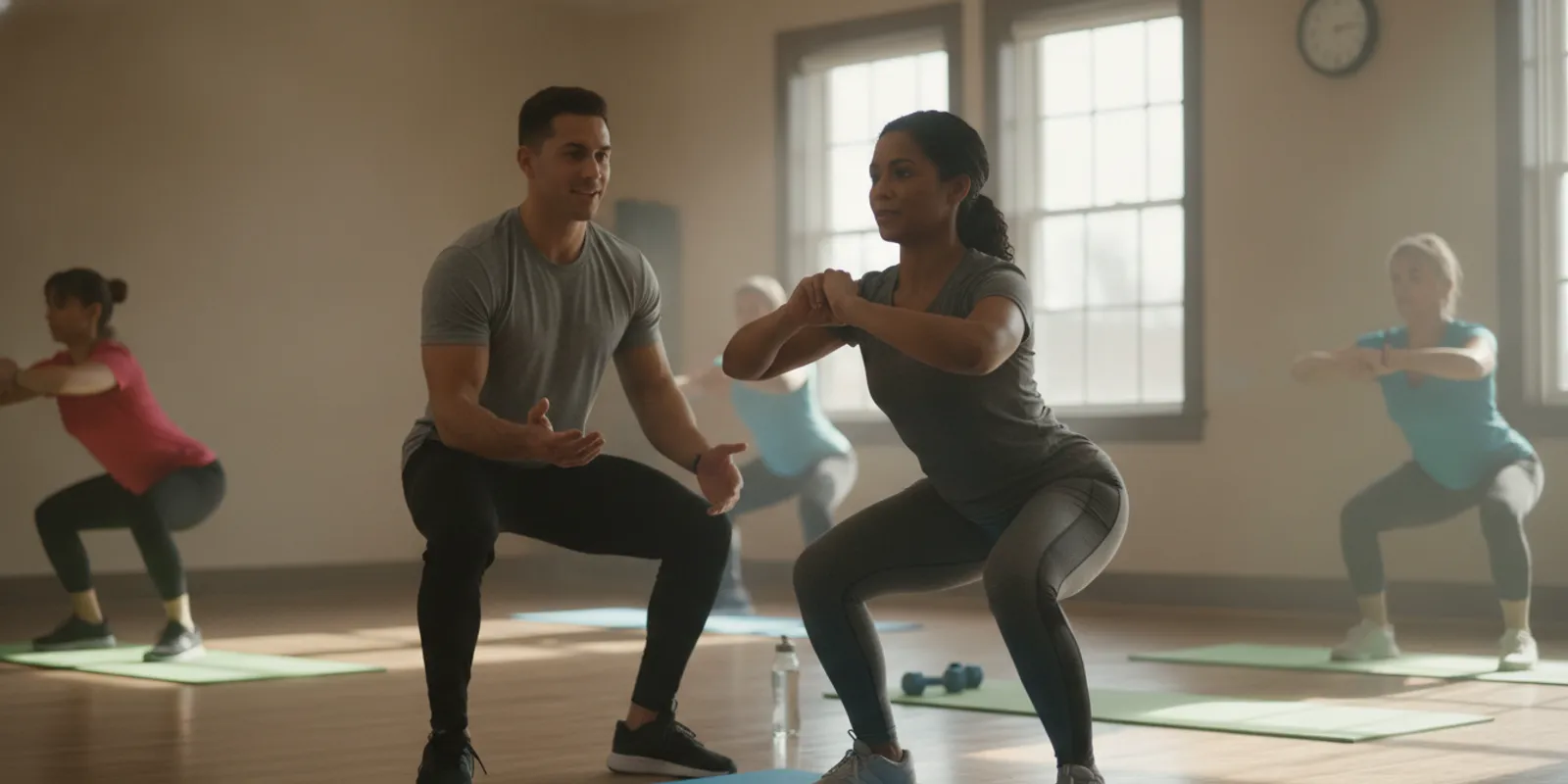
For a squat-like movement, a coach might suggest sitting to a chair and standing again, using a support, or reducing the range. For a push movement, the person might use a higher stable surface rather than a lower one. For conditioning, the option might be slower marching or walking instead of a faster interval. A coach could also reduce the number of rounds or give a longer transition. One person may need a different adjustment from another, even when both are new to class.
Scaling can apply to the sequence, not just a single exercise. If alternating stations feels too fast, complete the resistance portion first and the conditioning portion afterward. If a class uses several movements, ask whether you can learn one or two before adding the rest. If the exercise is unfamiliar, ask for a demonstration and a chance to practice before the pace increases. A clear, smaller plan can be a better starting point than a complicated one performed hurriedly.
Before class, tell the coach if there is a movement you are unsure about or a constraint you want them to know. You do not need to share personal details with the whole group. You can ask privately how to make a movement easier, how rest works, and what to do if a movement does not feel right. A coach can guide exercise options, but fitness coaching is not medical treatment. If you have a health concern, injury question, or uncertainty about whether exercise is appropriate, consult a qualified health professional.
During a session, stop and ask if you feel pain, dizziness, unusual shortness of breath, or unwell. Do not treat discomfort as a challenge to overcome by matching someone else. If an option still feels confusing, ask for another explanation or pause. A good adjustment should make the task clearer, not pressure you to ignore what you are experiencing.
Monroe Twp Boot Camp describes coach-led small-group workouts with beginner movements that can be scaled, along with private training and other fitness options. Its workouts are described as about 45 minutes or less. Ask what a current session includes and how a coach handles alternatives; do not assume every class uses the same sequence, equipment, or intensity. The gym’s guide to gym exercises can help you collect questions about movements, but an online description is not a substitute for a coach demonstrating an option in person.
How can you tell whether a session is manageable?
Manageability is more than finishing the session. You should have enough information to understand what you are doing, enough recovery to stay in control, and a way to ask for changes. You should also be able to tell the difference between ordinary effort and a warning that you should stop. A session that ends with you feeling confused about the movements or pressured to keep pace may need a different structure.
Use a simple set of observations during the workout. Can you follow the coach’s directions? Can you move without rushing? Can you recover between efforts? Is the exercise version clear? Are you able to pause if you need to? These questions help you decide whether to continue, rest, ask for a change, or end the session. They are not a medical screening and cannot determine whether exercise is safe for every person.
Afterward, write down a few concrete details rather than a general judgment such as “good” or “bad.” You might note: “I understood the chair squat after a demonstration,” “I needed a longer transition between stations,” or “the short walk felt easier than the fast stepping.” A record like that gives a coach useful information. It can also help you choose one reasonable adjustment for the next session.
Suppose your first workout includes two strength stations and a walk. You understand the first movement but feel uncertain about the second. That is a reason to request more instruction or an alternative, not to add speed. Suppose instead that the resistance work feels controlled but the walk interval feels too long. Ask whether to shorten it or take a longer recovery. Small adjustments let you keep the overall idea while making the session more usable.
Likewise, if you finish with energy but have not yet learned the movements, do not assume the answer is to add intensity. You might use the next session to repeat the same movements and improve familiarity. If you find that a plan consistently fits your schedule and feels clear, you can discuss a gradual change with the coach. Progress is not limited to heavier loads or faster intervals; becoming more confident with a familiar routine is also a useful kind of practice.
How can you organize hybrid training across a week?
Some people prefer to combine resistance and conditioning in one visit. Others prefer to separate them across days. The choice depends on schedule, preferences, recovery, and what a coach recommends. You do not have to train every day or use the same format at every session. A weekly plan should be realistic enough to follow and flexible enough to change when life gets busy.
For example, a person with one available workout day might include a brief strength block and a comfortable walk in the same visit. A person with two days might practice strength movements on one day and take a walk on another, or include a little of both on each day. Someone with an irregular schedule could focus on attending a manageable session when possible rather than committing to an ambitious pattern they cannot maintain. These examples illustrate ways to arrange activity; they are not a required schedule.
Leave room for recovery and ordinary life. If one session leaves you too tired to perform the next one comfortably, discuss changing the duration, pace, or spacing. If work or family responsibilities interrupt a routine, return with a manageable session instead of trying to make up missed activity by doubling the workload. Consistency is built by making a plan that can bend, not by treating every missed day as something to repay.
Write a simple weekly outline if that helps: which days might work, what activity you expect to do, and what your fallback option is when time is short. A fallback could be a shorter walk or a few familiar movements, provided those choices are appropriate for you. Keep the outline flexible. A calendar is a planning aid, not a promise that every session will happen exactly as written.
One useful distinction is between a goal and a schedule. “I want to practice resistance movements and keep walking” describes a direction. “I will do a particular workout at a fixed time every day” may be too rigid if the schedule changes. A workable plan can include a preferred option and a simpler alternative. Ask a coach what a shorter version of a session might look like rather than assuming that less time makes a workout pointless.
How can hybrid training fit different starting points?
A beginner who has not exercised recently may need a slower introduction, more instruction, and more recovery. Someone who already walks regularly may be comfortable with the conditioning portion but new to resistance movements. Another person may have experience with equipment but prefer gentle conditioning. The label “beginner” does not describe every skill or preference, so it helps to explain what is familiar and what is new.
For a person unfamiliar with strength work, a first goal could be learning the names and basic shapes of a few movements. The resistance portion might use body weight, a chair, or another simple option, while conditioning stays easy. For someone who knows basic movements but is new to group classes, the main adjustment might be learning transitions, following cues, and becoming comfortable asking for rest. For someone returning after time away, the first sessions can be about re-establishing a comfortable pace rather than trying to resume a previous workload immediately.
Busy parents and professionals may value a session with a clear beginning and end. Monroe Twp Boot Camp describes workouts as about 45 minutes or less and offers group boot camp and private training. Ask about current options and how to request an introduction. Do not infer a specific timetable from examples on a website; the available class schedule and appointment details should be confirmed with the gym.
If you prefer individual attention, ask whether private training is available and how it differs from a small-group session. If you like the encouragement of a group, ask how beginners are introduced to the movements and whether people work at different levels. These questions help you decide which coaching format is comfortable. They do not require you to choose a permanent path before you have learned what each option involves.
Keep your first-month expectations focused on process rather than a dramatic outcome. You can aim to understand the routine, identify movements you enjoy, learn how to request an adjustment, and find a schedule that fits. Do not treat a particular amount of weight loss, body-composition change, or strength gain as guaranteed by a workout format or a fixed number of days. Individual results vary.
What should you ask before joining a class?
Ask what the first visit involves, how to request a class, whether a coach demonstrates the exercises, what a beginner should expect, and what to bring. Ask whether the session is group or one-to-one and how you can take a rest. If you have a movement you are unsure about, ask how to raise that question before the workout starts. The goal is to understand the process, not to prove that you already know how to exercise.
Monroe Twp Boot Camp says first-time visitors should arrive a few minutes early, wear comfortable exercise clothes, and bring water, a mat, and a towel. The gym asks visitors to keep sneakers off the main exercise mats. Check with the gym for current details before you go, since equipment and procedures can vary. Arriving early can give you time to ask where to put your things and how the class is organized.
The gym describes a first free class as a request process. The website’s form language invites a person to fill it out and book, but it does not show a class date or time on the form. Treat it as a request, not as a confirmed reservation. Ask what happens after submitting the form, how a date is agreed, and whether there is anything else to complete before arriving. A friend or spouse needs to request a separate pass. The introductory class is not a free membership, free private training, or a free body-composition assessment.
The business describes several options, including group boot camp, private training, a 63-day habit program, kickboxing, nutrition coaching, and InBody body-composition assessments. Ask what each option involves and which questions are best handled before you start. Do not assume that a particular service is included with another program, that an assessment is free, or that a specific price or contract term applies. The gym’s beginner strength training guide is another place to review basic questions before speaking with a coach.
What does hybrid training not promise?
A combination of strength and conditioning does not guarantee weight loss, a particular body-composition change, a target result by a fixed date, or improvement in a health condition. The term describes how activities are combined; it is not a result claim. Individual experiences vary, and results depend on many factors that a workout label alone cannot control.
Be cautious of turning an example into a promise. A person may find that a regular routine helps them practice movement and make exercise part of the week, but that does not establish a guaranteed transformation. A 63-day program name does not mean that a particular outcome will happen in 63 days. A body-composition measurement can provide information about muscle, fat, and water, but it is not a diagnosis or a guarantee that a particular number will change.
Monroe Twp Boot Camp offers InBody assessments by inquiry. The gym describes a noninvasive measurement of muscle, fat, and water and a result sheet available in a short time; the specific scanner model, fee, frequency, and preparation guidance are not established here. Ask the gym directly what the assessment includes and how to understand the information. Do not use a measurement as a substitute for care from a qualified health professional.
Similarly, nutrition coaching is not the same as medical nutrition therapy, and exercise coaching is not injury rehabilitation or medical care. If you have a health condition, injury, medication question, or uncertainty about activity, ask an appropriately qualified health professional. You can then discuss any relevant exercise guidance with the coach. The coach can help with exercise options and class instructions, but should not be treated as a substitute clinician.
How can you make the routine repeatable?
Repeatability starts with a structure you can remember. Keep the first plan modest: one or two familiar resistance movements, one comfortable conditioning option, and enough time to rest and ask questions. Once that pattern is clear, decide whether to repeat it or make one small adjustment. A simple plan is easier to evaluate than a workout that changes every part at once.
Use a brief session note with four prompts: What did I practice? What felt clear? What needed a change? What question should I ask next time? A sample note might say, “Practiced sit-to-stand and wall push; understood both after demonstration; wanted a longer rest before the walk; ask about an easier stepping option.” That is specific enough to guide a conversation without turning exercise into a test or requiring detailed tracking.
Make a plan for common interruptions. If you arrive late, ask the coach how to join safely rather than trying to catch up mid-exercise. If you miss a session, return to the next appropriate opportunity without doubling the workload. If the original movement is unavailable or uncomfortable, ask for an alternative. A routine is more resilient when it includes a way to adjust rather than requiring perfect conditions.
Choose a reminder or cue that fits daily life. You might set out comfortable exercise clothes, put a water bottle by your bag, or note a question for the coach. These small preparations do not guarantee attendance, but they can make the next step easier. If a class time does not suit your schedule, ask about current alternatives rather than relying on an old example or assuming that an unverified time is available.
Review the routine after several sessions, not after every difficult minute. Look for a pattern: perhaps you understand the movements better, need less explanation, or have learned which pace works for you. If the schedule is hard to maintain, ask about a different format or a shorter way to stay engaged. If the exercises remain confusing, request more instruction. Keep the changes practical and specific.
How do you decide whether group or private coaching fits?
A small-group setting can offer a shared class environment and coach-led instruction. It may suit someone who enjoys being around other participants and can follow a common session with individual adjustments. Ask how the coach communicates variations, whether the group works through stations, and how a beginner can get help without feeling rushed. The answer should make clear how instruction and rest work in that particular class.
Private training offers a one-to-one format, which some people may prefer when they want more individual attention or have many questions about the basic movements. Ask how sessions are structured, whether they can focus on strength and conditioning, and what the process is for choosing an appropriate starting point. Do not assume a particular length, rate, package, or inclusion; those details need to be confirmed with the gym.
Neither setting is automatically superior. A person who likes community may appreciate a group, while someone who wants a quieter introduction may want to ask about individual coaching. A person can also ask whether private training may be used alone or alongside group classes, because the gym describes both options. The choice should be based on what is currently offered and the kind of instruction that feels useful to you.
Use a short list of questions when you contact the gym: What happens after I ask about a class? How are beginner movements demonstrated? Can I take a rest or use an alternative? What should I bring? What are the current options for group and private training? These practical questions make it easier to understand the format before you commit to a routine.
How can you keep strength work controlled when adding cardio?
Plan the transitions before you begin. If your strength movement requires a mat or equipment, know where it is and how you will move to the conditioning activity. Avoid adding a new exercise during a transition just because another participant is doing it. Follow the instructions for your own version, and ask before changing equipment or position.
Keep the first repetitions slow enough to understand. If a movement begins to feel rushed, pause or reduce the number of repetitions. If conditioning follows, start at a comfortable pace rather than trying to carry the same intensity from the strength segment into the next one. It can be helpful to leave a short recovery between blocks so you can refocus and hear the next instruction.
There is no need to make every station a race. A circuit is one possible format, not a requirement for hybrid training. You can use a sequence with distinct blocks: practice strength, recover, move comfortably, and finish. Or you can alternate the elements with ample rest. If you cannot maintain control in an alternating format, ask to do the activities separately.
Ask the coach how to judge the intended effort. A simple question such as “Should this pace feel comfortable, or is this interval meant to be harder?” can clarify the session. Do not assume that everyone should be working at the same effort. People may use different loads, movement ranges, and recovery periods while participating in the same class.
Frequently asked questions
Is hybrid strength training suitable for beginners?
It can be adapted for a beginner when the exercises, workload, pace, and recovery are appropriate. Ask how the coach demonstrates alternatives and how to take rest. Start with a small number of movements and add complexity only when the plan is clear and manageable.
Do I need weights?
No. Body-weight movements can provide resistance, and walking can provide a conditioning option. Equipment can be used when it fits the exercise, but it is not what defines hybrid training.
Should I do strength work or cardio first?
There is no single order for everyone. If your priority is learning strength movements, you may prefer to practice them before a more tiring conditioning block. You can also use a gentle warm-up first or place the activities on separate days.
Does hybrid training guarantee weight loss?
No workout format guarantees weight loss or a particular timeline. Individual results vary. Focus on a suitable routine you can repeat, and seek qualified professional guidance for health-related concerns.
How do I request an introductory class?
Contact Monroe Twp Boot Camp to ask about its first free class and what happens after you submit an inquiry. The request is not a confirmed date or time. A friend or spouse needs to request a separate pass.
Ask about current training options
Make a manageable first step
Hybrid strength training is a way to plan resistance exercise and conditioning together, not a promise of a particular result. Begin with clear instructions, movements you can control, and a pace that leaves room to rest and ask questions. If you want to explore a coach-led introduction in Monroe, contact Monroe Twp Boot Camp to ask how to request its first free class; a request does not confirm a reservation.